Large pergola projects
Players' Pergolas Beside Sports Courts: Equipment and Breaks in Play
Plan courtside player pergolas around breaks, hydration, equipment and return to play.
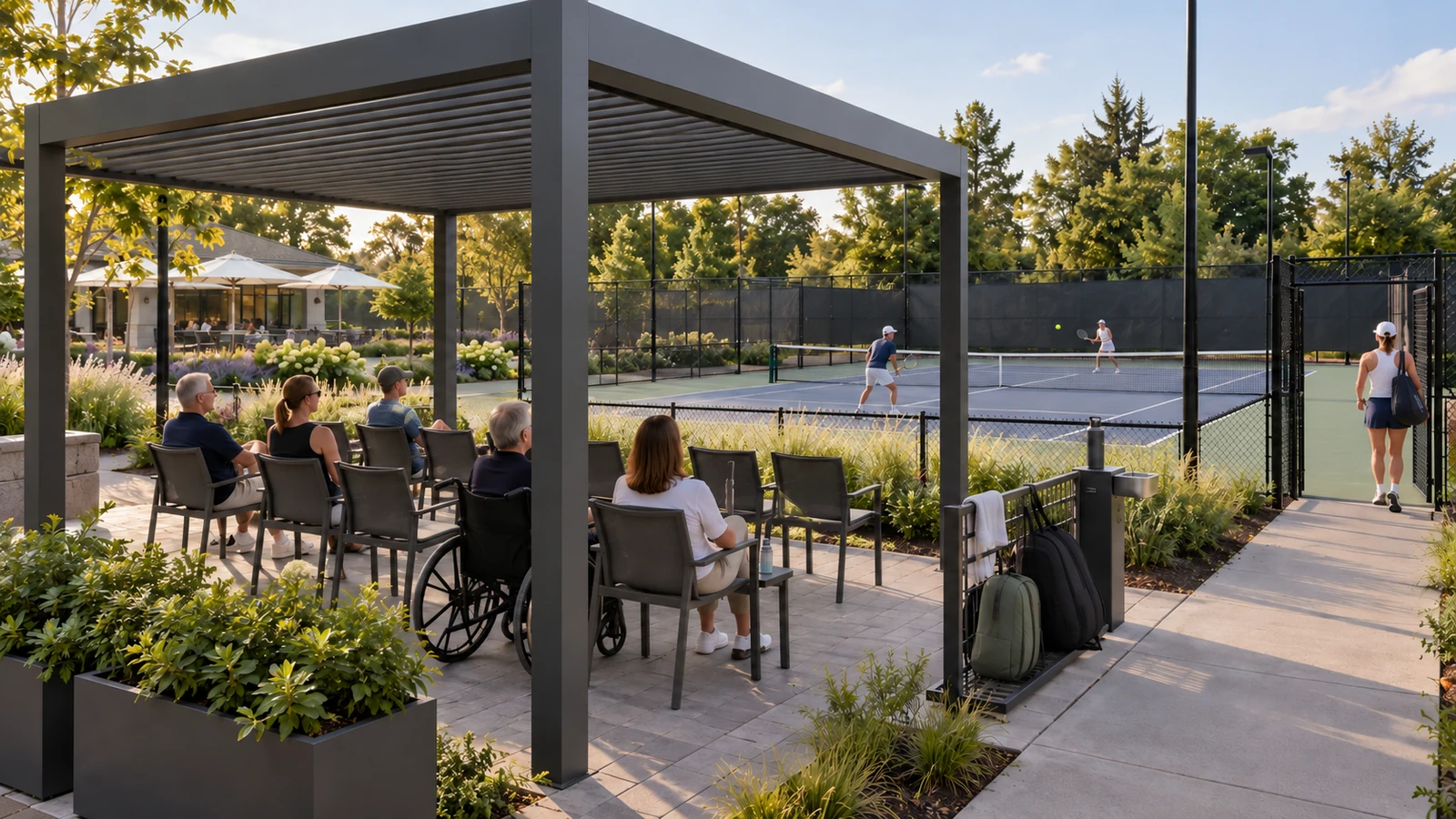
Start with breaks and return to play
Arrange a players' pergola around breaks, refreshments, equipment and returning to play. People leaving the court may need a seat while waiting players gather near entry, creating conflict if both use one narrow opening. Confirm sport boundaries, entry procedures and break activities with the facility operator before choosing a location. UK HSE amateur-sports guidance provides management context but does not establish ball-impact protection. TTH200/220 is a candidate subject to the actual site review, not a structure automatically suitable for every sport's safety zone merely because it stands beside a court.
Assign places for equipment and refreshments
Bags, rackets, bottles and supply boxes occupy useful floor space, so give them positions clear of seats and the return route. Do not treat unreviewed beams or posts as supports for bags, nets or equipment, or assume impact resistance. Review installation, cleaning and power for any refreshment equipment separately. Trial people changing shoes, adjusting equipment and waiting to enter, observing whether positions or timing need adjustment. Boundaries and operating procedures differ by sport and should be checked by the responsible teams instead of copied directly from a generic courtside illustration.
- Separate equipment storage from return-to-play routes.
- Check space while people sit and adjust equipment.
- Confirm entry and break procedures with the operator.
Test player rotation between matches
Imagine consecutive activities on a community court. The previous group sorts equipment under the roof while the next arrives ready to enter. If everything is piled beside the court-facing opening, the route may briefly become blocked. Compare dedicated storage, alternative waiting positions and operator-managed rotation through a trial. This scenario tests activity flow without setting universal headcounts or sports clearances. When weather or another event requires closure, follow the operator's established arrangements. Gathering players beneath the pergola alone does not establish that they have reached an appropriate refuge.
Confirm operations and engineering separately
Provide the sport, boundaries, entrances, equipment and timetable for review of foundations, drainage and relationships with nearby facilities. Any independent ball protection or equipment support needs appropriate design; pergola appearance cannot substitute for verification. Operators should define opening, lost-property, cleaning and reporting duties, revisiting the plan when activities change. UK HSE venue principles can assist circulation review without replacing local sports-facility requirements. Judge the rest area by orderly breaks and return to activity, with clear limits and responsibilities, rather than extending its uses through unverified performance claims.
Can a courtside pergola also serve as ball protection?
Do not assume it can. Ball-impact suitability requires review for the actual structure, screens and sport. Check equipment storage, waiting and return routes with the operator. Where protection is needed, specify and assess it separately with qualified specialists.
More questions, practical answers →