Solar canopy decisions
Pedestrian Routes Under Solar Carports: Separating Reversing Traffic
Trace the walk from vehicle to entrance and identify conflicts created by reversing, columns and charging equipment beneath a solar carport.
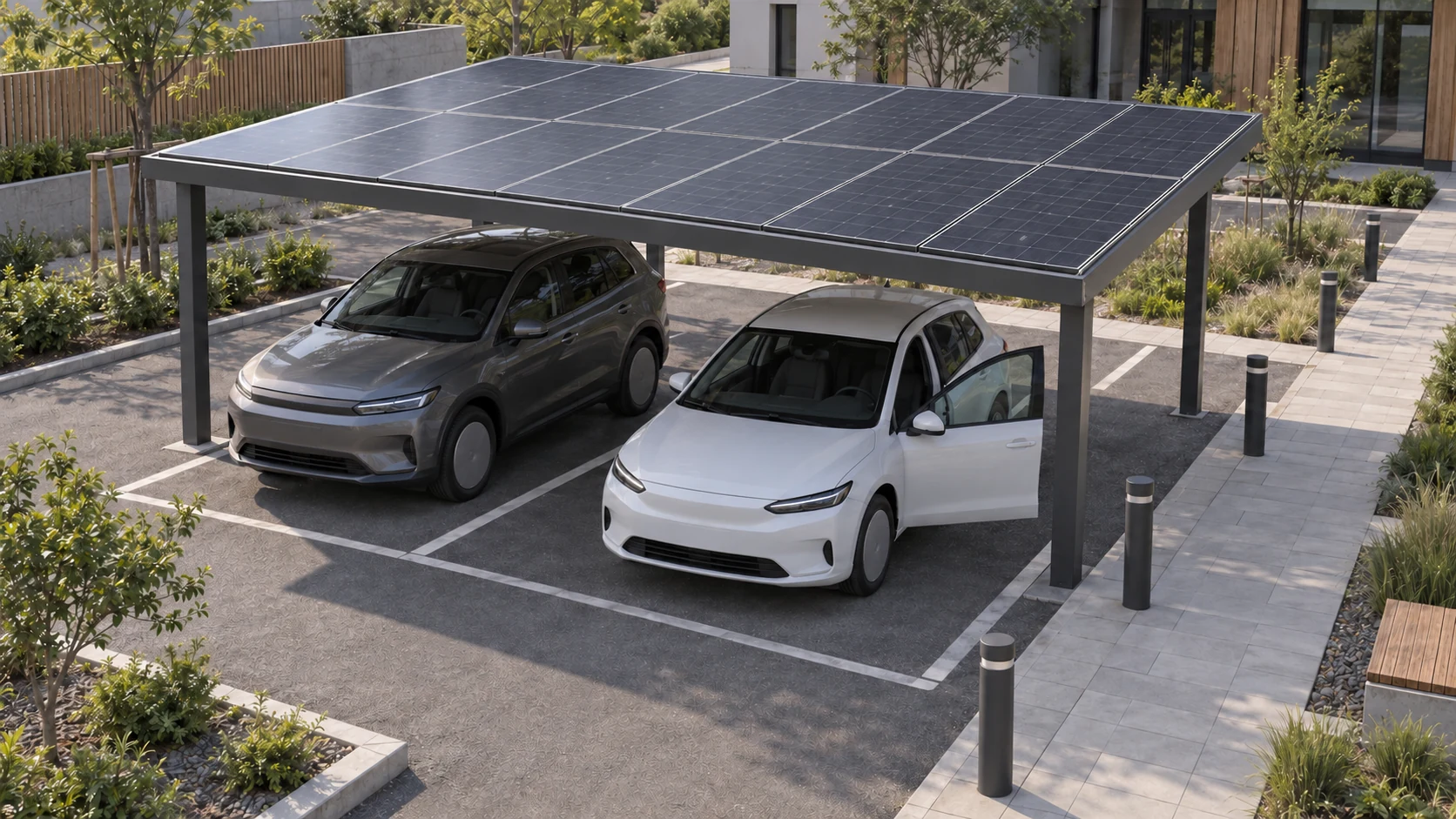
Start the route where people leave their vehicles
Begin by asking where people get out, which entrance they use and how luggage, pushchairs or mobility aids travel with them. A path beside the building may omit the crossing needed to reach it from a bay. Draw the entire arrival route, marking reversing vehicles, turns and restricted driver views. Solar carport columns and equipment can change visibility, so a previously uneventful layout still needs review. Include the return walk from the entrance to the vehicle: the same location can present different visibility problems when approached from the opposite direction.
Check continuity as well as width
A usable route needs a continuous surface, clear direction and space free from equipment intrusion. Review base edges, outlets, charging cables, temporary signs and open cabinet doors. A generous path can still fail at a single point blocked by a vehicle or equipment. Traffic separation should follow the site design and local requirements; improvised obstacles can create new trip or collision hazards. ADA standards inform applicable US accessibility reviews, while other jurisdictions require their own rules. Include actual users in route checks rather than treating a drawn width as sufficient evidence.
- Record crossings on commuter and visitor routes.
- Check whether drivers and pedestrians can see each other.
- Overlay equipment operation and service areas on the plan.
Test a visitor arriving in the rain
Imagine a first-time visitor parking under the canopy in rain and taking the shortest visible route to the entrance, directly behind a row of reversing cars. A marked path farther away may not be used. A site test can reveal whether the entrance is obvious, the route follows natural movement and directions are clear. Possible responses include better arrival guidance, an appropriately located crossing or changes to some bays, subject to professional site review. Adding a warning sign alone does not resolve the underlying conflict. Repeat the check under nighttime lighting to confirm that the intended route remains recognizable.
Include temporary uses: an event bin or registration desk may push pedestrians into the vehicle lane. Give event organizers the route drawing and identify the areas that must remain clear.
Keep the route usable in everyday operation
After acceptance, temporary parking, event items or maintenance enclosures can still obstruct the route. State who checks it, who removes obstructions and how alternative access is provided during service work. HSE workplace transport guidance helps organize pedestrian and vehicle questions but does not replace local parking or fire requirements. Handover drawings should show the final route and nearby equipment. Review them when chargers are added or parking rules change. A clear, continuous route with an assigned operational owner is more useful than one that exists only on a design drawing.
Is a painted pedestrian line enough beneath a solar carport?
Check the complete route from vehicle to entrance, including bases, cables, equipment and temporarily parked vehicles. Coordinate interactions with reversing and turning traffic, review daytime, nighttime and maintenance conditions, and assign responsibility for inspections and temporary alternatives. Recheck the route when equipment is added.
More questions, practical answers →