Solar canopy decisions
Solar Carports Near Delivery Routes: Checking Vehicle Swept Paths
Review delivery-vehicle turning envelopes, low canopy edges and unloading positions instead of relying on passenger-car dimensions.
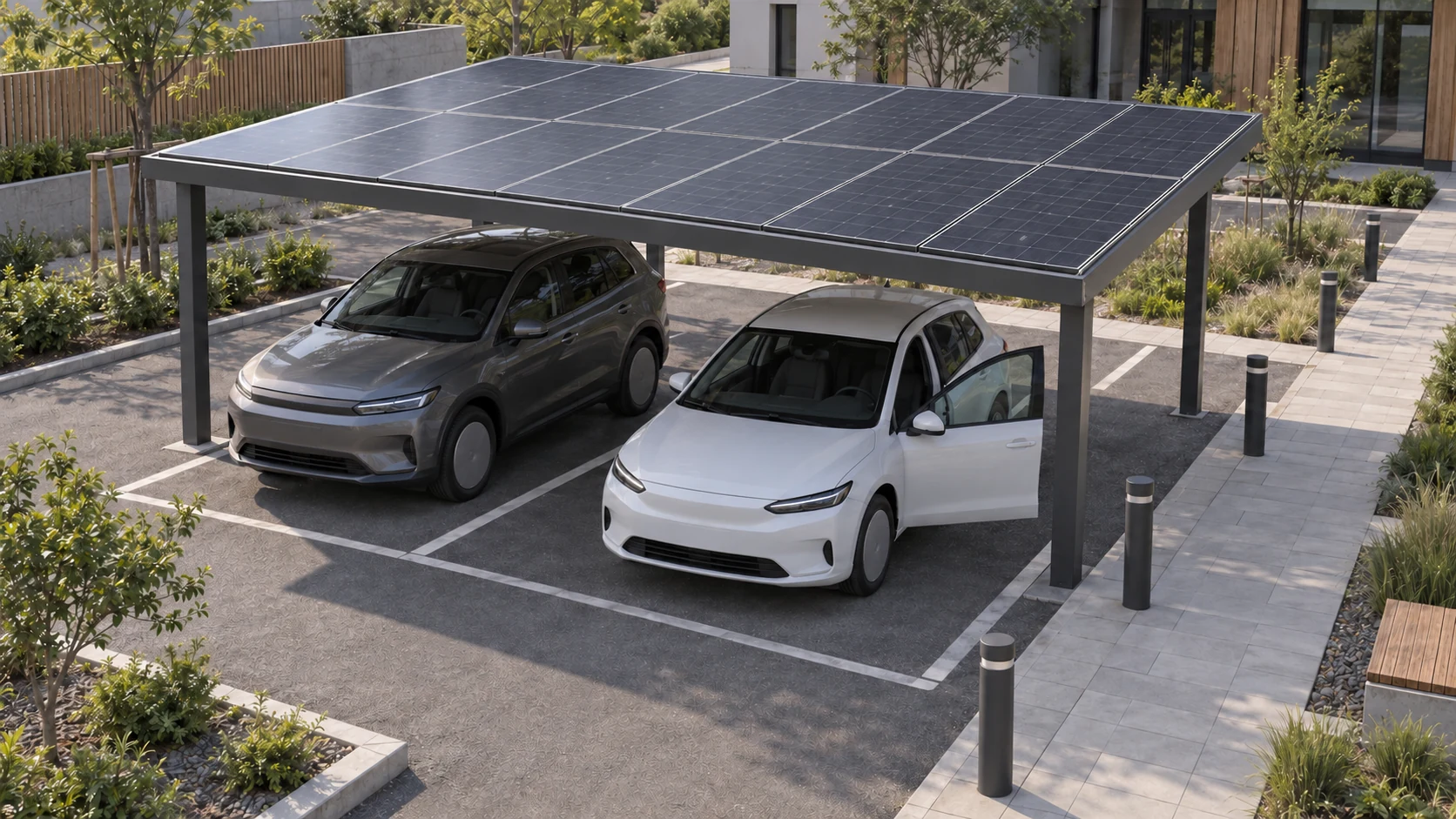
Collect information about actual delivery vehicles
When delivery vehicles pass near a solar carport, ask site operations and regular carriers for vehicle types, actual envelopes, approach directions and unloading methods. A truck's front swing, rear overhang and swept path differ from a passenger car's. Tail lifts or side unloading require additional working space. Use those facts in the design rather than inferring truck access from bay width. Record reasonably foreseeable seasonal changes in vehicle use and have traffic and engineering professionals determine the necessary checks, instead of leaving drivers to test the layout after construction.
Check both ground movements and overhead contact
Overlay swept-path drawings with columns, protective equipment, roof corners and projections. Avoiding a column at ground level does not establish clearance for the upper body near a low roof edge. Cab passage likewise does not prove the rear body or trailer can follow. Show door opening, tail-lift deployment, handling staff and waiting vehicles so unloading space is not omitted. Reversing requires visibility and operational review; a camera fitted to the truck does not replace layout assessment. The responsible professionals should confirm the site's traffic arrangements.
- Review arrival, turning, unloading and departure.
- Check upper and lower vehicle envelopes separately.
- Preserve pedestrian and emergency access during deliveries.
Test a hypothetical tail-lift delivery
Imagine a delivery truck that drives past the new canopy successfully but blocks the main pedestrian route when its tail lift is lowered. A driving-only review would miss the conflict. The team could examine moving the stopping position, changing delivery timing or relocating unloading, checking each consequence such as another lane or plant-room entrance becoming obstructed. No option is automatically best; the operating state must be included. Involve the people receiving goods, because they know how items move from lift to store and which routes the carport project must preserve.
If drivers normally use empty bays to turn, test the fully occupied car park too. Do not treat unmanaged vacancies as permanent turning space unless operations explicitly reserves that area.
Record the conditions for delivery access
Give parking and receiving staff the approved vehicle range, routes, unloading positions and timing constraints. Recheck them when carriers change vehicles, roadside equipment is added or adjacent parking is altered. DOE carport and HSE transport guidance identify interactions between vehicles and structures; neither proves impact resistance for a particular TTH system. A canopy column should not serve as an improvised vehicle stop. Retain the reviewed route plan and ensure that signs, ground layout and everyday operations continue to match it.
If a truck cab passes the carport edge, can the whole vehicle pass?
Not necessarily. Review the upper body, rear overhang or trailer swept path and changes caused by gradients. Check doors, tail lifts and handling areas separately. Use actual vehicle data and site drawings for a professional review of the complete access and working route. Include conditions when every parking bay is occupied.
More questions, practical answers →