Large pergola projects
Keep a caravan or trailer route before placing a large pergola
Review the whole caravan or trailer route, including turns and overhead equipment, before fixing pergola positions.
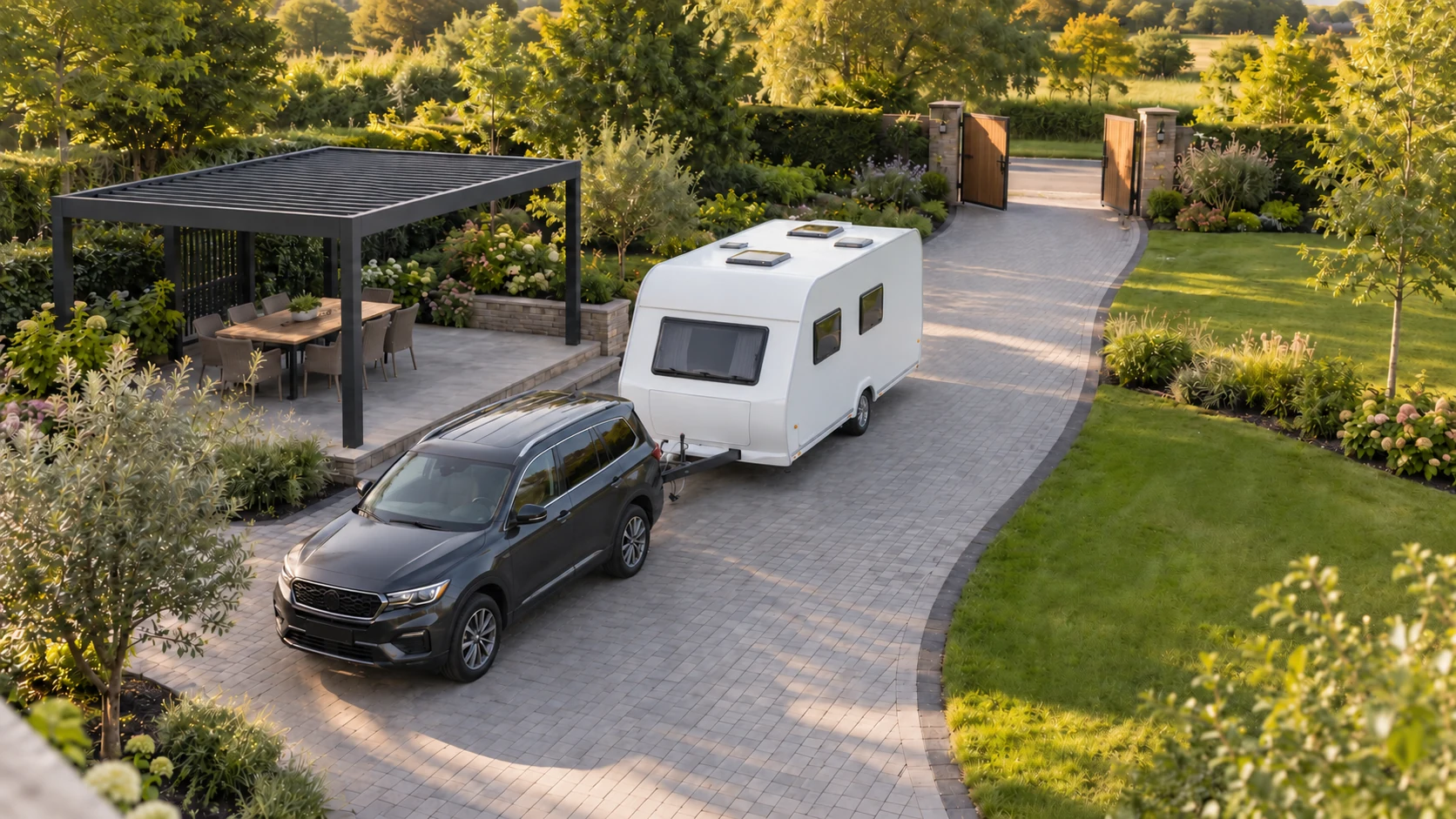
Map the vehicle journey before the pergola
A garden used mainly for relaxation may occasionally need a caravan, trailer or large item moved to the rear. Treat that journey as a real design requirement. Record the entrance, destination and whether a towing vehicle must enter too, rather than drawing only the parked body as a rectangle. Caravan and Motorhome Club route advice highlights knowing vehicle dimensions, but does not establish access through any particular garden. Give accurate equipment details and the site plan to suitable people for assessment before fixing candidate pergola positions that could interrupt an existing use.
Check overhead, corner and ground conditions
Include relevant real attachments rather than relying on brochure dimensions that omit roof equipment or projections. Review corners, gates, branches, eaves and proposed lights; blank space on a plan is not proof of three-dimensional clearance. Ground suitability and loading need separate confirmation, since a pedestrian patio is not automatically a vehicle route. Do not squeeze a vehicle into an unverified gap as a test or place helpers in trapping positions. Any actual movement should be handled by capable people following vehicle requirements and an appropriate site arrangement.
Suppose entry works but the turn does not
Imagine a wide entrance leading to a turn before the storage position. A proposed post may be far from the gate yet still occupy space required later in the manoeuvre. Have suitable people assess the complete route using the actual vehicle before adjusting the pergola position or choosing another storage area. Share any known vehicle replacement plans, while recognising that clearance for today’s equipment cannot guarantee access for every future model. Passing through the gate is only one stage; reaching the destination and leaving again both belong in the assessment.
Preserve the assessed route in the final plan
Mark the assessed route and its conditions on the final plan and share it with pergola, landscape and fencing contractors. Explain the retained space before pots, cabinets or temporary furniture gradually occupy it. Keeping a passage does not establish that the pergola is suitable for vehicle parking or maintenance; those are different requirements. Retain the vehicle details, drawing revision and assessment records and revisit them after changes to gates or accessories. Planning for an occasional but important journey helps preserve both everyday relaxation and the garden’s existing practical uses.
- Provide vehicle details including actual attachments.
- Assess entry, exit, turns and ground conditions.
- Share the retained route with every relevant contractor.
Does a post gap wider than a caravan guarantee access?
No. Assess attachments, height, turns, towing arrangements, ground and the whole journey. Do not force a trial through an unverified space. Preserving passage also does not establish suitability for parking or other vehicle uses.
More questions, practical answers →