Solar canopy decisions
Does a Solar Carport Need Battery Storage?
Separate daytime use, energy shifting and outage backup before deciding whether a solar carport needs batteries.
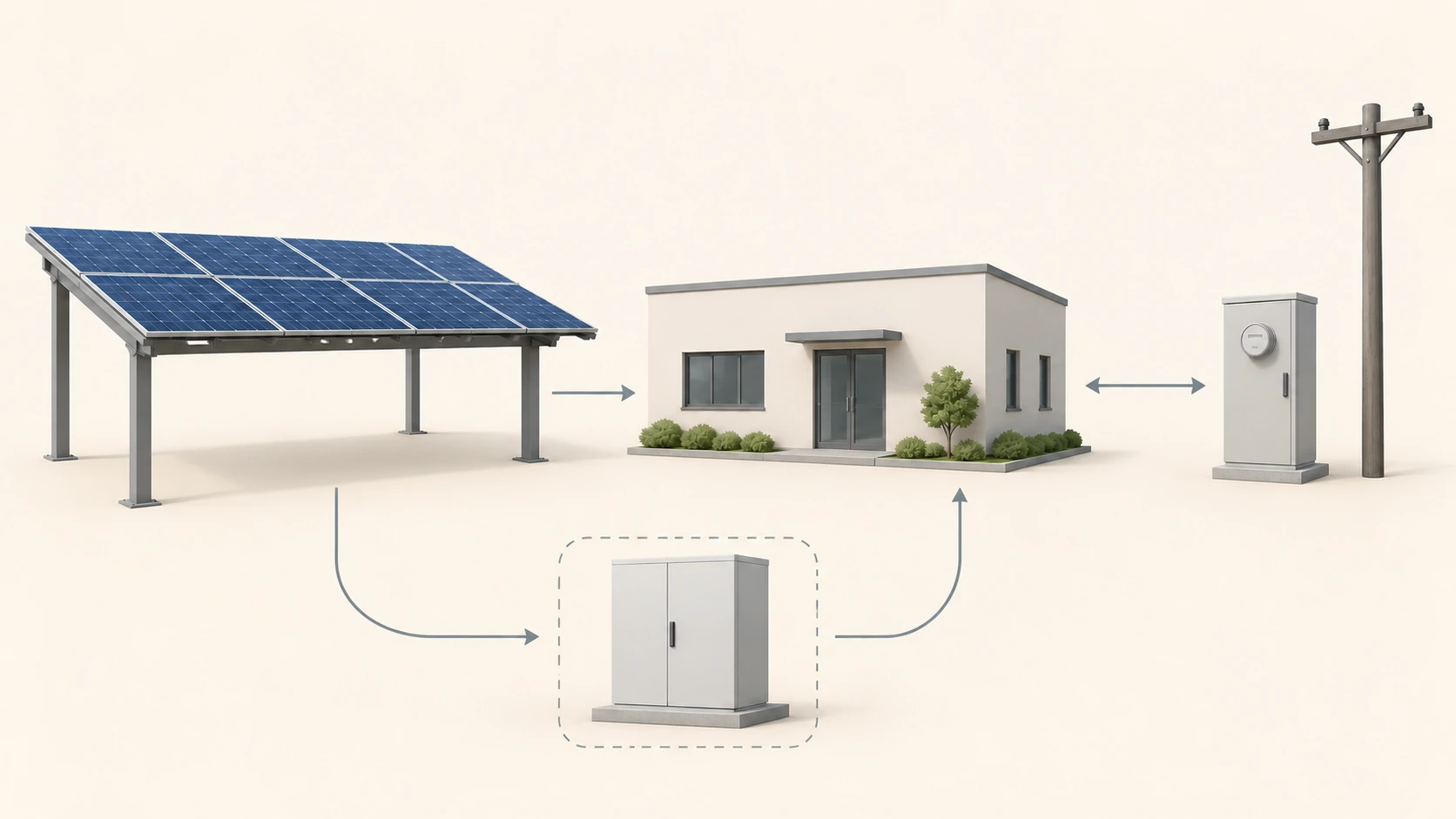
Translate the battery question into a task
Whether a carport needs batteries depends first on the problem. Continuous daytime demand may favor direct solar use. Moving some daytime energy into evening involves time shifting. Keeping selected loads running during an outage involves a designed backup system. These are different tasks, not one generic storage need. State the loads, timing and acceptable interruption, and verify demand and connection conditions. Selecting a large battery before defining the purpose can produce a complete equipment list with no clear function and no useful basis for comparing proposals.
Compare with and without storage under matching conditions
Ask professionals to describe energy flows without storage before explaining how a battery changes them. Compare equipment, controls, siting, maintenance and approvals, not capacity alone. Storage adds operating and replacement tasks whose costs and assumptions should be visible. Any commercial assessment depends on local charges and project conditions, not another site's payback period. List outage capability separately: adding a battery does not automatically allow the entire building to operate normally during a failure.
- Identify shifting, backup or another defined objective.
- Request comparable energy-flow descriptions with and without storage.
- List backup loads, controls and maintenance separately.
Consider evening community activities
Imagine a community venue with little daytime demand and regular evening events. Review event timing and actual loads rather than assuming a full charge and discharge every day. Weekends, weather and cancellations change scenarios. Compare storage with other permitted energy arrangements without inventing consumption to justify the battery. If emergency supply is also desired, define the backed-up circuits for professional assessment. One venue may have two objectives, each requiring evidence rather than a single capacity figure supposedly answering both.
Have departments agree priorities when their objectives differ. Finance may focus on charges, facilities on upkeep and operations on continuity; a supplier slogan cannot reconcile those needs automatically.
Keep the decision tied to explicit conditions
The recommendation may be storage now, later study or no storage for the present, each with reasons and review triggers. DOE storage and resilience information explains functions but does not establish backup capability in a TTH canopy. Quotes should assign batteries, inverters, controls, installation and commissioning. A no-battery decision can still include professionally reviewed space or interfaces, without guaranteeing compatibility with future devices. Define needs alongside the people responsible for upkeep so the energy decision fits operations.
Does using electricity at a solar carport after dark always require a battery?
Not automatically. Confirm permitted supply arrangements and the objective. Night use may involve the grid or designed storage; outage backup needs separately defined loads and controls. Review actual demand, charges and upkeep rather than equating evening use with a particular battery purchase.
More questions, practical answers →