Solar canopy decisions
Charging at a Solar Carport After Sunset
Understand where night-time solar carport charging gets its electricity and how to describe grid, storage and solar contributions accurately.
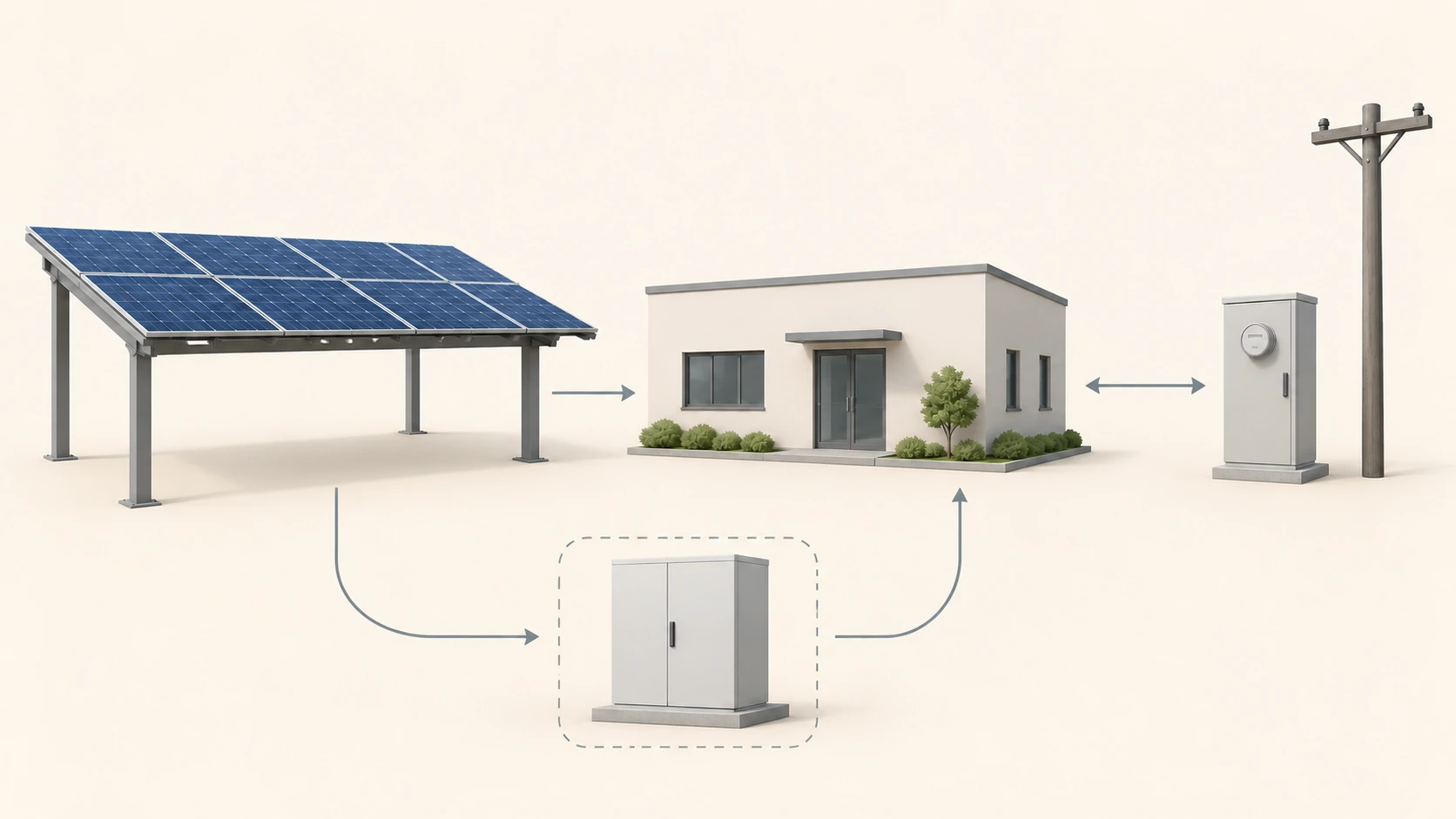
Separate generation time from charging time
When usable sunlight is absent, a canopy cannot continuously charge vehicles from instantaneous solar generation. Night service needs another supply, such as the grid or energy previously stored in a battery, depending on the connections and controls. Solar panels above parking describe where generation occurs, not the source of every charging session. Explain the arrangement with a simple diagram linking solar, building demand, storage, the grid and chargers. Identify which equipment is installed and which is only a future option rather than presenting a concept as an operating system.
Consider both storage energy and power
A plan to shift daytime solar into evening charging must specify stored energy, discharge power and operating priorities. Battery selection depends on daytime surplus, night charging, other building demand and controls, not simply roof area. Losses, reserved energy and changes in available capacity also matter. DOE solar and storage guidance explains energy shifting, but does not replace equipment design, local fire review or backup duration calculations. Ask the design team to document assumptions and show outcomes under different weather and demand conditions rather than quoting one attractive example.
- Label instantaneous solar, battery discharge and grid imports.
- Explain storage priorities and reserved energy.
- Match night service targets to the actual supply design.
Test the promise against several low-solar days
Imagine a campus generating by day and charging duty vehicles at night. After several low-solar days, its battery may contain little solar energy while vehicles still need to depart. The plan must state whether grid charging, reduced charging power or operational changes are allowed. This is a service strategy question, not a recommendation for a fixed battery size. Comparing one sunny day with one evening misses consecutive low-generation periods and concentrated demand. Normal night operation and operation during a grid outage also require separate assessment; a battery does not automatically enable islanded supply.
Keep public descriptions consistent with the system
Use consistent supply descriptions in procurement documents, signs and dashboards. State when charging mainly uses the grid. A displayed storage contribution needs a defined metering boundary, period and estimation method. Similar annual solar generation and annual charging consumption do not show that every session receives instantaneous solar power. Renewable electricity claims may also involve local energy attribute rules. At acceptance, obtain system diagrams, operating modes and representative records so managers can explain daytime, night-time, low-battery and outage behavior before making public service commitments.
Does adding storage guarantee no grid use at night?
No. Grid use depends on daytime surplus, available battery energy, charging demand and controls. Low-solar periods or higher demand may exhaust storage. Document the supply mix and limits, and assess normal night operation separately from outage operation.
More questions, practical answers →