Retractable awning choices
Drips near an awning seam: what to establish before replacing fabric
Establish permitted rain use, the actual drip location and recent changes before treating one observation as proof that fabric replacement is necessary.
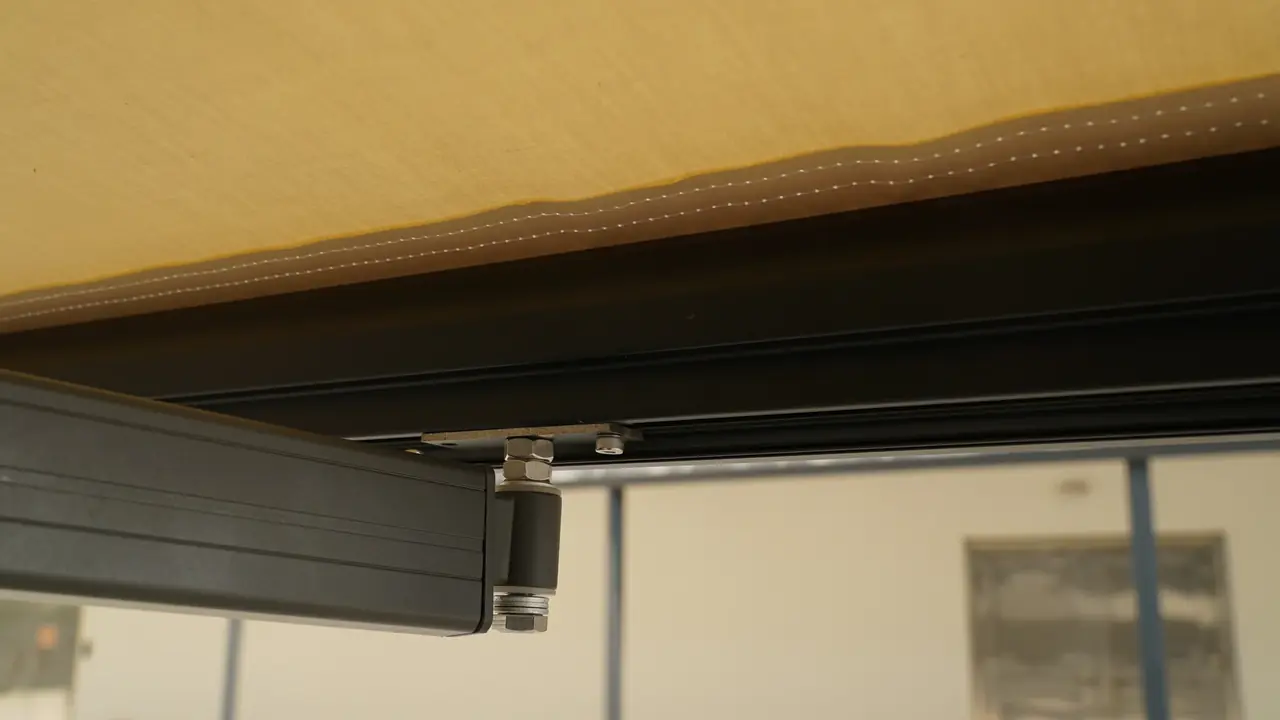
Check whether the observed use is permitted
First review the selected awning instructions for rain, fabric state and retraction rather than immediately diagnosing a failed seam. If the current use is outside the product’s scope, that scenario cannot establish failure of an unpromised rain-shelter function. Give the provider the model, state and observed location, retaining uncertainty where documentation is missing. Do not prolong exposure, create pooling or change pitch to amplify or suppress the symptom. Establishing permitted conditions first ensures the subsequent assessment addresses the right question instead of testing an assumed capability.
Record where water appears and how it changes
Photograph the overall arrangement and drip area safely, recording conditions, permitted operating state and recent cleaning, fabric replacement or adjustment. Water appearing below a seam still needs an appropriate source assessment; the owner need not diagnose it in the initial report. Avoid tape, sprays or other improvised treatments that alter fabric and obscure evidence. Abnormal sagging, pooling or mechanism issues require the instructed pause and service response, not repeated rolling to squeeze water out. The record should let the provider review the actual condition rather than a modified version of it.
Include fabric and configuration in the assessment
If the issue began after recovering the awning, provide old and new material identifiers, installation records and timing. If longstanding, explain previous use and treatment. The provider should determine relevant checks for the system rather than assuming an entire fabric replacement from the word dripping. Ask for diagnostic scope before comparing possible remedies and provisional costs. Generic seam sealants or adjustment dimensions are inappropriate without compatibility evidence. An assessment is valuable because it reduces unnecessary or incorrect replacement, not because it supplies the fastest universal explanation over the phone.
Review the result within the agreed scope
After service, record the assessment, work performed and agreed follow-up observation, leaving unverified outcomes identified. If the original system does not suit the desired continuous rain-shelter use, compare a suitable alternative instead of repeatedly asking ordinary shading fabric to perform another function. Neither a repair record nor marketing copy should turn a local treatment into an all-weather waterproof upgrade. Align purpose, service scope and acceptance conditions so the owner knows what has been resolved and which desired outcomes were never established capabilities of the original proposal.
- Establish permitted rain conditions for the actual model.
- Keep location, weather and recent-treatment records.
- Define assessment scope before choosing repair or recovering.
Will thicker replacement fabric automatically solve seam-area dripping?
Not automatically. Check permitted rain use and have the provider assess location, configuration and recent changes. Thickness alone establishes neither compatibility nor rain performance. Avoid improvised coatings, tape or adjustments; define the issue and appropriate acceptance conditions before choosing a repair or replacement.
More questions, practical answers →