Solar canopy decisions
Will a Solar Carport Work During a Power Outage?
Distinguish ordinary grid-connected PV from designed backup and verify outage loads, transfer behavior and commissioning evidence.
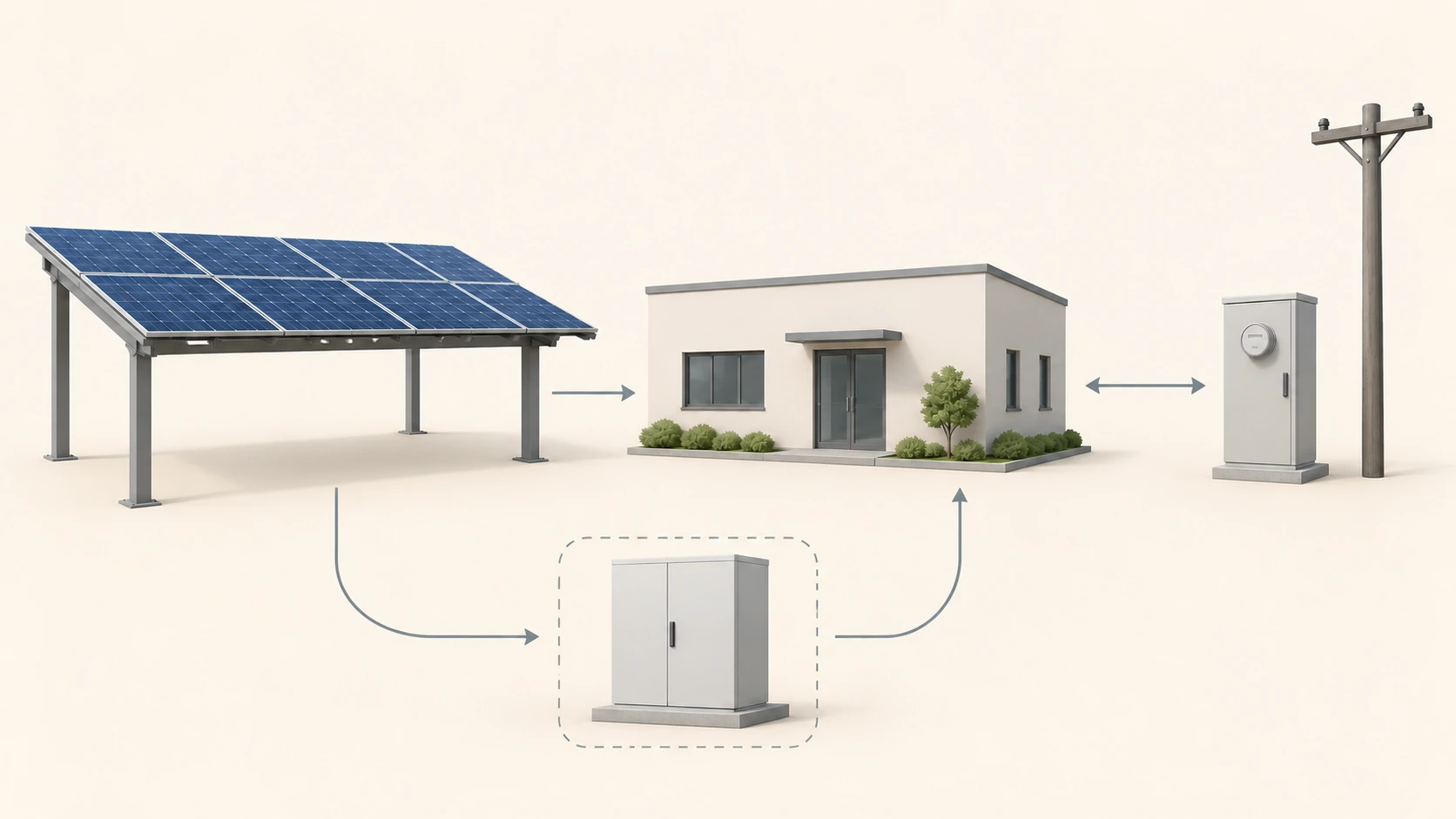
Start with the limits of ordinary grid-connected PV
Outage supply depends on more than sunlight. Ordinary grid-connected PV differs from a system designed to serve selected loads after losing the grid; backup needs appropriate equipment, controls and transfer arrangements. Panels do not establish that sockets, lights or chargers remain available. DOE inverter guidance explains that operation without grid support requires a suitable design. State outage objectives explicitly and have professionals confirm whether the proposal provides them, instead of inferring complete capability from hybrid, smart or battery-equipped labels.
List the loads that need continuity
Define backup equipment, duration, priority and acceptable interruption. Emergency lighting, communications, office outlets and vehicle charging have different requirements; normal operation of the entire campus is not a sufficient brief. Electrical professionals should identify included circuits, coordination or separation and approved behavior when energy is insufficient. This guide provides no transfer wiring or switching procedure. Life-safety or required emergency functions need appropriately qualified, jurisdiction-specific assessment rather than reliance on a generic solar description.
- Identify included and excluded backup circuits.
- Explain transfer, recovery and insufficient-energy behavior.
- Include commissioning evidence for the actual configuration.
Test a nighttime outage scenario
Imagine a car park wanting limited guidance lighting during outages but receiving a broad round-the-clock power claim. Ask what the design can do at night, with different storage states and outage durations. One successful daytime demonstration does not establish all scenarios. Professionals can propose tests matching confirmed loads, including boundaries and untested conditions. Public information should identify backed-up facilities so drivers do not arrive during an outage expecting a charging service outside the design.
Record the loads connected and equipment states during testing. Without those conditions, a photograph of illuminated lights documents only that observation, not the complete scope of backup service.
Give operators a precise functional description
Handover should identify the approved configuration, backup tasks, status indications, professional contacts and trained operators' roles. Users must not bypass protection or connect PV circuits to other loads informally. Distinguish TTH structural supply from separate electrical scope; DOE resilience material does not establish default brand features. Added loads, replacement batteries or control changes require backup review. A versioned functional description supports real outage operations better than a marketing name combining solar and storage.
Does a carport battery mean every device will work in an outage?
No. Confirm designed backup operation, included circuits, available power and energy and transfer controls. Qualified teams should provide configuration-specific documentation and tests, with review after added loads. Do not bypass protection or use temporary wiring to create backup supply.
More questions, practical answers →