Large pergola projects
Large Pergolas Near Transport Interchanges: Waiting and Luggage
Review luggage, pushchairs and passing pedestrians in pergolas near transport interchanges.
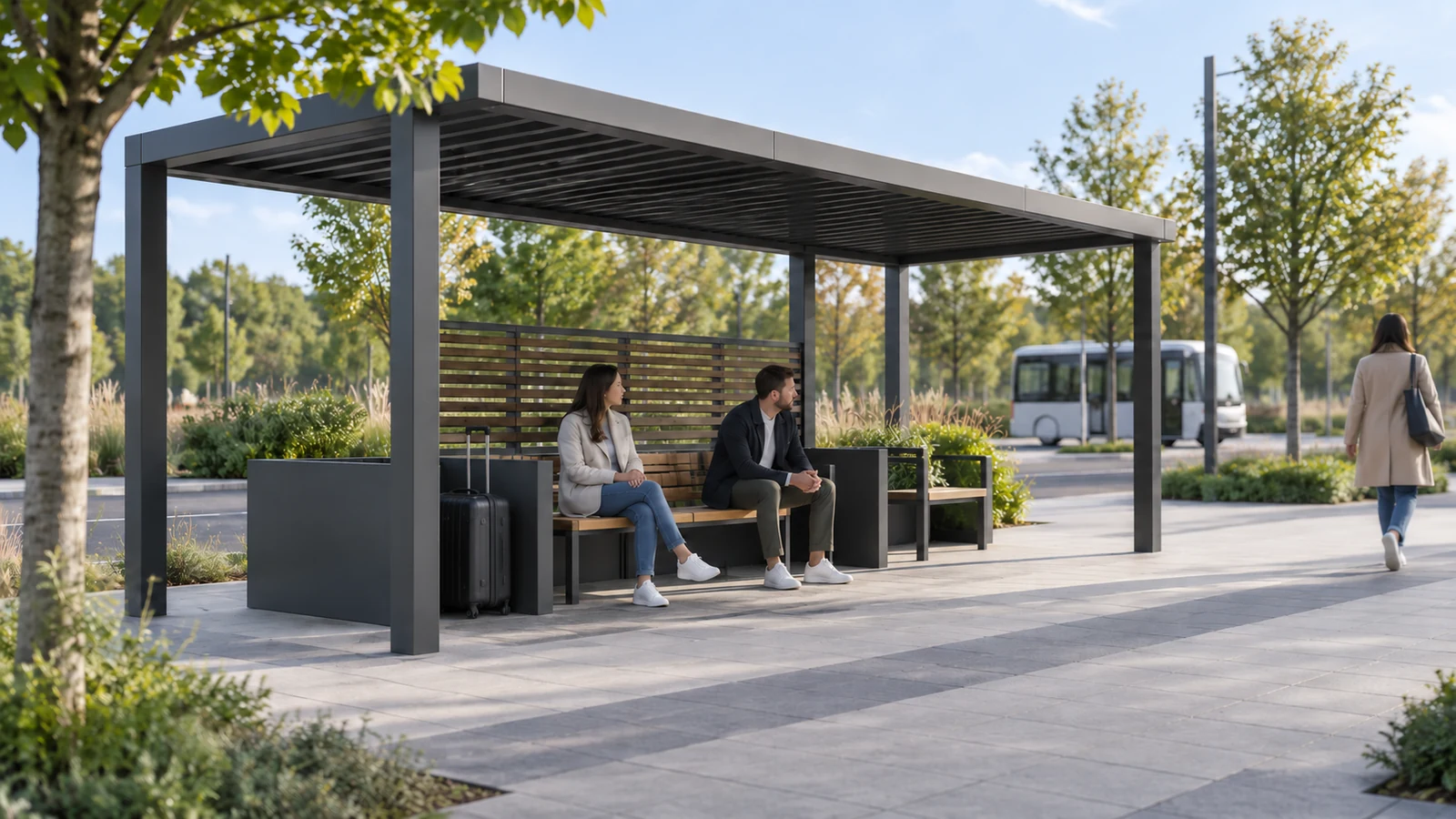
Define which part of the journey it serves
Clarify whether the pergola serves meeting others, organizing luggage or waiting to enter a formal transport facility. These uses can have different operating and approval boundaries; a general waiting pergola is not automatically an approved bus stop or passenger shelter. TTH200/220 may be considered for an adjoining public area subject to property, transport-operator and local review. Observe passenger surges and luggage after vehicle arrivals rather than judging the quiet site alone. Waiting visitors should understand their route while people passing through avoid weaving between seating groups and bags.
Test the space around seats with real luggage
Assign places for suitcases, pushchairs and shopping trolleys without assuming everything fits beneath a seat. Trial wheeled-luggage turns, people bending to organize belongings and companions standing nearby. Review continuous access under applicable requirements, using ADA provisions only where relevant in the United States; a sign alone does not establish a compliant arrangement. Check information displays from seats and approach directions so visitors do not cluster at the entrance merely to read them. UK HSE queue guidance informs arrival and departure review but cannot replace specialist transport-facility design requirements.
- Observe short surges after vehicle arrivals.
- Trial luggage, pushchairs and companions.
- Keep information viewing and through routes understandable.
Trial the period after a vehicle arrives
Imagine several groups stopping under a pergola after a vehicle arrives, checking information and organizing bags. Seats facing away from the main route may encourage luggage to accumulate behind them, forcing other travelers between cases. Compare seating orientation, a defined short-stay position or relocation of information through trials. This scenario specifies no universal baggage allowance or capacity and establishes no platform compliance. Record how congestion actually develops, then let responsible teams assess workable changes. Increasing roof size is not the only response to a problem caused by orientation and activity.
Define boundaries and disrupted-service arrangements
Document management boundaries, hours, nearby transport flows and intended activities before professional review of foundations, drainage, lighting and access. If delays extend waiting, the responsible operators must decide how to manage arrivals rather than assume unlimited people can gather under the roof. Define cleaning, lost-property and fault reporting across organizational boundaries. Check whether baggage obstructs routes and revisit the plan when information points or vehicle arrangements change. Explaining which stage of the journey the pergola serves helps visitors use it appropriately and avoids presenting ordinary public space as an unverified transport facility.
Does installing a pergola near a station make it an official passenger platform?
No. General waiting space and formal platforms may have different transport, accessibility and approval requirements. Confirm the intended use and management boundary with the responsible organizations, then test luggage and pedestrian movement. A roof or model name is not evidence of transport approval.
More questions, practical answers →