Solar canopy decisions
Accessible EV Charging Under Solar Carports
Review the complete accessible charging journey beneath a solar carport, including transfer space, controls, cables and onward routes.
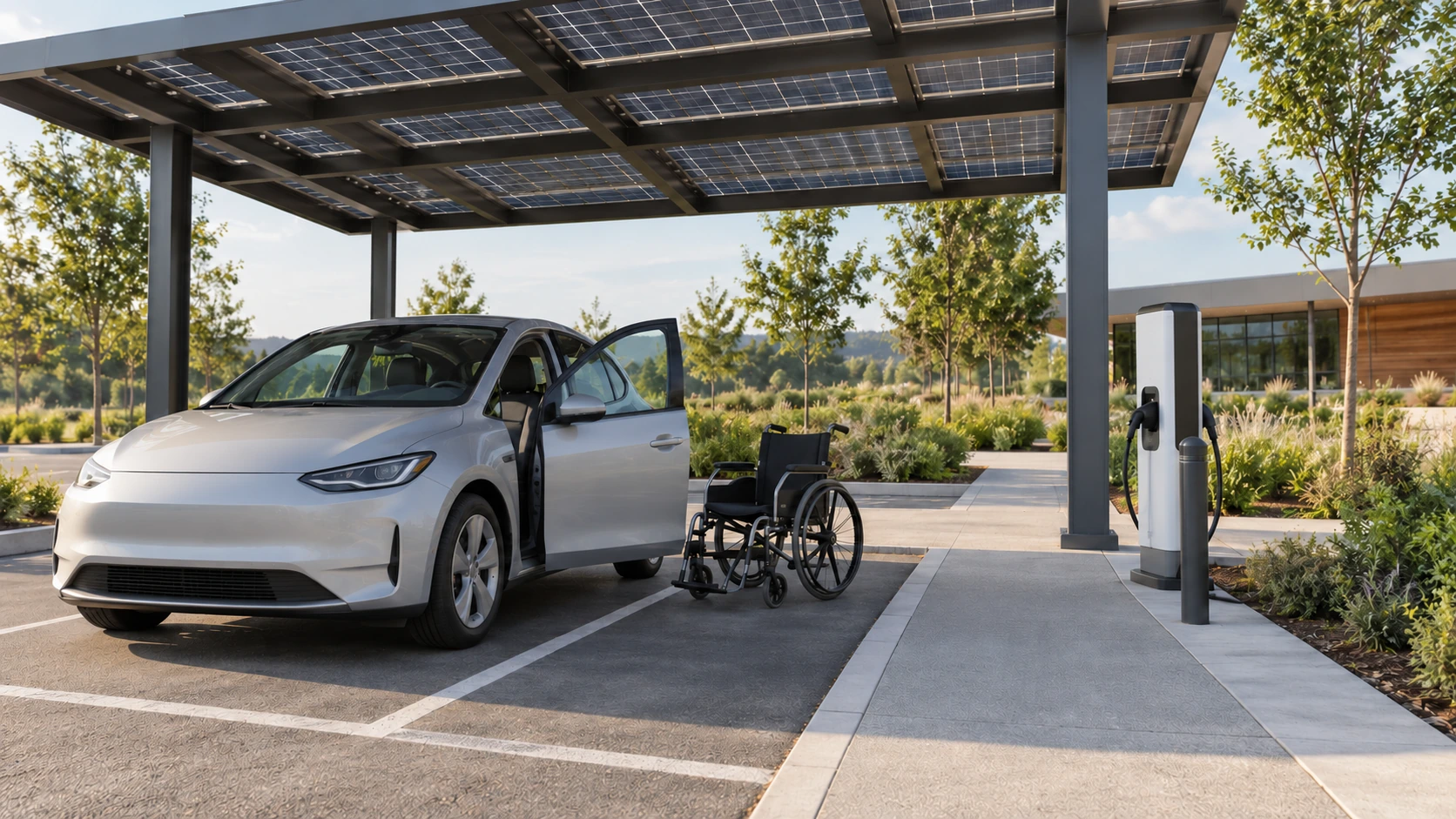
Review the entire charging journey
Accessible charging is more than a wide marked bay. A user must arrive, transfer or deploy mobility equipment, reach the charger, operate its controls, connect the vehicle and continue safely to the building. Different charging port locations make cable reach, weight and movement around the vehicle important. Canopy columns, protective barriers and drainage features can consume essential space, so coordinate them on one plan. The US Access Board's technical assistance helps identify issues, but recommendations and applicable legal requirements must be distinguished, with local rules checked elsewhere.
Coordinate structure and equipment around usable space
Check operating space in front of equipment, movement beside and behind vehicles, and the connection to pedestrian routes. Protective posts should not block the only usable approach, and stored cables should not cross circulation space. Control reach, screen legibility and payment or identification methods also affect usability. Use dimensioned vehicle and equipment layouts, involving users or an accessibility adviser where appropriate. Determine required dimensions from the project's applicable standards rather than assuming that a canopy model or generic marketing diagram demonstrates compliance.
- Check transfer, connection and onward routes together.
- Coordinate columns, barriers and operating space.
- Separate legal requirements, guidance and product evidence.
Test use with different vehicle arrangements
In a hypothetical public lot, a charger at the head of a bay may serve vehicles with rear charging ports. Apparently clear space beside the charger may still require a user to pass behind the vehicle or stretch a cable across a route. Test representative dimensions and port positions, including ordinary parking variation. One successful demonstration is not a guarantee for every vehicle. If changing bay use affects existing accessible parking provision, assess that supply and its signs separately so that adding charging does not create another access barrier.
Include operations in acceptance
Acceptance should cover signs, cable storage, lighting, assistance after payment failures and the effects of standing water or temporary obstructions, as well as drawings and measurements. Assign responsibility for alternative instructions during faults and for keeping routes clear. Recheck areas later occupied by furniture, storage or added equipment. Shade alone does not establish accessibility for the charging service. Give suppliers the site conditions, applicable requirements and complete user scenarios, asking them to identify their scope and interfaces requiring other specialists. Keep review and correction records.
Can a charger simply be added to an existing accessible bay?
That requires a separate review. Check equipment access, controls, cables, vehicle ports and onward routes, plus the effect on existing accessible parking provision. A qualified local team should coordinate the layout and distinguish guidance from applicable legal obligations.
More questions, practical answers →